Learning
Every finished verb leaves a result with a receipt. This is how the system is built to learn from those results after it ships, what has been measured so far, and the rules that keep it honest.
Results from our evaluation tasks, measured on October 29–31, 2026. Nothing here has been promoted, admitted or deployed.
What continuous learning means here
Noun
Checked results
Every finished verb leaves a result with a receipt, and Tessera records how the run went. Workers can add a report of what went right and what went wrong.
Verb
Learners
Learner runs turn execution reports into memory of similar past work, statistics on which paths succeed, and routing advice. What they write is advice, never a permission.
Verb
Tuning after deployment
Small open models are tuned on checked examples of one job, and a tuned model replaces its base only when a rule fixed in advance says it wins. So far the examples are example, made from templates, and none come from real work reports.
Learning is nouns and verbs too: an authorized worker claims each learner run and each tuning step, and everything they write is a versioned noun. There is no hidden learning service.
The loop
One round of tuning. Each step is a verb that an authorized worker claims, and each leaves a noun behind.
Generate examples
Leaves: Example batches
Templates fill typed slots and compute every label. No model writes a request, an example or a label.
Curate
Leaves: A training set
Repeated rows, and rows that match a test row, its request or its template, are rejected with a reason.
Freeze a test set
Leaves: Frozen tests
Whole tool families are held out of training, and the test’s hashes are recorded before any model sees it.
Train an adapter
Leaves: A candidate adapter
A small add-on trains on top of the base model. The base itself never changes.
Evaluate
Leaves: Evaluation runs
The candidate, the current champion and the unchanged base are scored on the same rows.
Decide by the rule
Leaves: A decision
The promotion rule, fixed in advance, asks for a real gain and no drop in valid output, refusals or general skills.
Reload check
Leaves: A reload record
The saved adapter, loaded onto a fresh copy of the base, must reproduce its replies exactly.
Promote or roll back
Leaves: The champion pointer
The pointer moves, or the champion stays. Every version is kept, so rolling back is moving the pointer back.
Then the next round starts from the champion, with new examples aimed at its failures.
Measured results
Exact match is the share of requests a model answered exactly right: the right tool with correctly typed values, or the right refusal. Nothing is repaired before scoring.
Llama 3.2 1B
12.0% to 50.7%
Exact-match accuracy on a fixed 150-task evaluation, after two promoted rounds on one local GPU.
Evidence Tessera’s continuous-tuning record
Llama 3.2 3B
52.0% to 72.7%
The same frozen test, after one promoted round in the same loop.
Evidence Tessera’s continuous-tuning record
Muse Glimmer 30B
93.3% to 99.3%
On a fresh 150-row test whose hashes were registered before scoring: +6.0 points, with a 95% CI of +2.0 to +10.7. The promotion rule passed 12 of 12 checks.
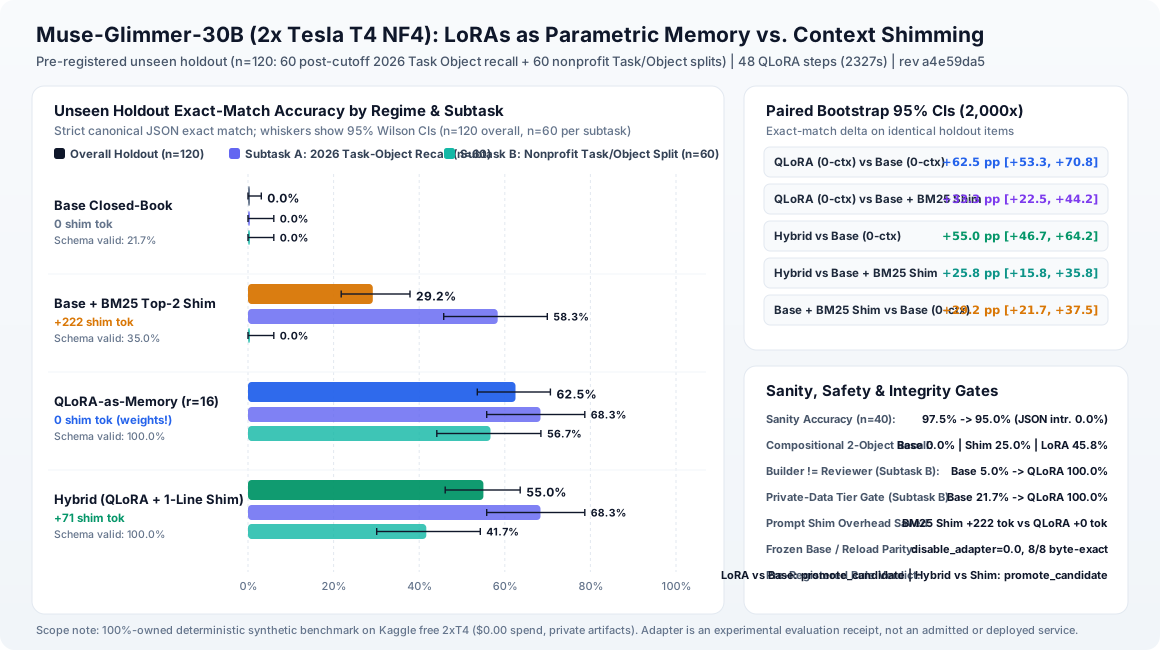
Muse Glimmer 30B (LoRA-as-Memory)
0.0% to 62.5%
Closed-book exact match on a pre-registered 120-row task-object recall and workflow test with 0 context-shim tokens (+33.3 points above a 222.3-token BM25 shim, 2.28 times faster, and 8 of 8 reload equivalence).
Evidence The LoRA-as-Memory run record, with every file’s hash
Llama 3.2 3B (Hybrid LoRA + Compact Pointer)
64.2% to 91.7%
Exact recall on a 120-row task-object and live-delta test when pairing a local LoRA with a 38.5-token schema pointer, cutting injected shim tokens by 91.0% vs a 427.6-token BM25 shim (8 of 8 reload equivalence).
Evidence The hybrid LoRA-as-memory and compact-pointer record
Llama 3.2 1B (Herma Shim Router)
26.7% to 98.3%
Full route exact match on a 120-row 5-action Herma routing and contributor-privacy test (vs 26.7% keyword rules and 10.0% zero-shot 1B), with 100.0% private-data refusal recall and 0.0% false refusals.
SIRA Self-Learning RAG + Herma Shims
23.3% to 100.0%
Recall@1 across 60 hard retrieval queries over 79 seed packs (MRR 0.341 to 1.000 in 1.0 round), cutting injected tokens by 82.8% at 0.30 ms retrieval and compiling 10 deterministic shims at 0.026 ms with 10 of 10 independent reviews.
Evidence The SIRA self-learning RAG and Herma shim benchmark record
Meta ARE 4D Scenario Matrix (1,000 Episodes)
32.5% to 67.5%
Stakeholder-blocked episodes (32.5%) vs safely approved episodes (15.1% direct plus 52.4% human-partitioned = 67.5%) across 1,000 4D scenarios spanning 25 domains.
Evidence The 1,000-episode Meta ARE 4D scenario matrix record
Safety rules
Every round follows the same rules. A round that fails any check leaves the champion where it was.
Frozen tests
Whole tool families are held out of training, and every test set is pinned by its hash, so a score always means the same rows.
Pre-registration
The promotion rule was committed before the first training round, and each fresh test’s hashes are recorded before any model sees it.
Contamination checks
Fingerprints reject any training row that matches a test row, its request or its template.
Reload equivalence
A saved adapter must reload onto a fresh copy of the base and reproduce its replies exactly before it can be promoted.
A promotion rule fixed in advance
A gain whose lower bound is above zero, and no drop in valid output, refusals or general skills. Keeping the base is a valid outcome.
Rollback
Adapters are never overwritten, and the champion is one pointer that keeps every version, so rolling back is moving the pointer back.
Honest limits
- Everything is made up, with one task per result: typed tool calls for Tessera’s own tools.
- Rounds start on demand rather than from live traffic, and exporting real runs for training is a documented design in Tessera rather than an active export.
- Adapter weights aren’t published.
- Nothing has been promoted or admitted. A promotion here moves only a private pointer that the next round compares against.
- The learners are implemented and tested on our evaluation fixtures rather than live client workloads.
Run it yourself
Tessera’s continuous-tuning guide has the loop, its commands and its tests. Without a GPU, a local CPU backend runs every verb, receipt and decision on a CPU, so you can check the plumbing first.
The library’s continuous tuning pack holds the same loop as nouns and verbs, with its own tested code. Like every pack in the library, it is a proposal.
The continuous-tuning guideThe continuous tuning packThe learning deckLoRA-as-Memory benchmark chart (SVG)Kaggle 2xT4 & vLLM fine-tuning guideModal, Baseten 2M TPM & Fireworks partner cascadeSIRA self-learning RAG benchmark (JSON)Meta ARE 1,000-scenario matrix (JSON)